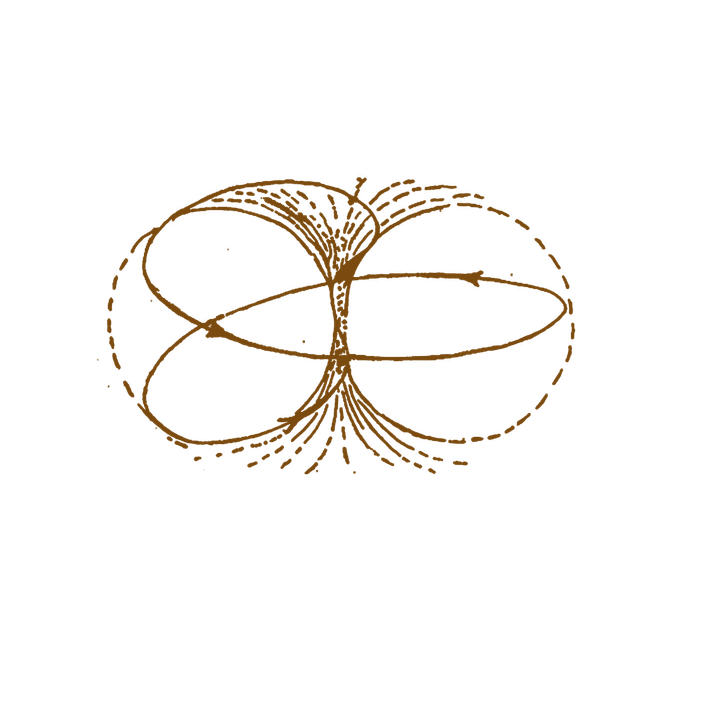
Hologram: the whole inscribed in each part
The word hologram comes from Greek:
holos — whole
gramma — inscription, trace, message
A hologram is a structure in which each fragment contains the information of the whole.
If it is divided, the whole remains present in each part.
Quantum physicist David Bohm spoke of the implicate order: a deep dimension where reality is not fragmented, but folded into an invisible totality that gives rise to the visible.
Neuroscientist Karl Pribram proposed that the brain functions holographically: memory and perception are not stored in isolated compartments, but distributed in patterns that contain the whole.
Later, Michael Talbot integrated these ideas into the holographic universe hypothesis: what we perceive as separate could be the unfolded expression of a profound unity.
If this is true, then fragmentation is apparent.
Loss is apparent.
Rupture is apparent.
The whole remains inscribed.
Wild: that which was not tamed
Wild comes from the Latin silvaticus: “of the forest”.
Wild does not mean primitive.
It means original.
It is that which exists before the norm.
Before the mould.
Before correction.
Taming does not occur only in behaviour.
It occurs in perception.
We learn to adapt.
We learn to inhibit instinct.
We learn to distrust intuition.
We learn to reduce ourselves in order to belong.
Layer by layer, the original structure is covered.
But covering is not erasing.
The wild does not disappear.
It retreats.
The illusion of fragmentation
We live in a culture that interprets symptoms as failures
and differences as deviations.
We try to correct what is actually protecting something deeper.
We try to optimise what is actually adapting.
If nature is holographic,
every conflict contains information about the whole.
Every repetition speaks to the entire system.
Every blockage points to a point of access.
There are no defective parts.
There are parts disconnected from the total context.
The problem is not who we are.
It is the narrative that separates.
Biological memory
The body does not forget.
Biology records every adaptation, every silence, every invisible pact.
But it also preserves the original structure.
Beneath social identity lies an older organisation.
An order that predates education.
That predates fear.
That predates the need for approval.
That order does not need to be constructed.
It needs to be remembered.
Wildness is not a state that is achieved.
It is a state that is unearthed.
Potential
If each part contains the whole,
then each human being contains their original coherence.
We are not projects under construction.
We are complete structures in the process of revelation.
Holograma Salvaje is a declaration:
That wholeness was not lost.
That intuition is not a luxury, but a biological function.
That instinct is not a threat, but intelligence.
That the body is not an obstacle, but organised memory.
What was covered up can emerge.
What was silenced can be heard again.
What was tamed can remember its original form.
Original state
We are all born with an intact wild nature.
Then comes adaptation.
But the hologram never breaks.
It only changes focus.
The whole remains inscribed in every cell,
in every impulse,
in every heartbeat.
Wild Hologram is not an idea.
It is a reminder.
The structure is alive.
The memory remains.
Original nature waits to be recognised.